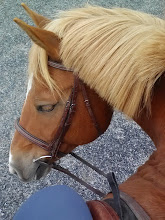
And so it begins - The Base
The base of good, effective riding is the establishment of the seat.
The seat is the rider's primary connection with the horse, affecting the its way of going. The seat determines whether the horse will move with impulsion, whether it will pull itself along with the front legs, whether it can perform correct and clean flying changes or concise sliding stops. A well developed seat provides security for the rider as it can follow the motion of the horse freely and not be in danger of losing that essential connection.
We once observed with wonder as our mentor and friend, Leann, rode a young draft cross in the field on a gusty, cold November day. The horse, feeling the wind beneath its tail, lept and bucked bucks upon bucks. Leann's body never budged in the saddle. She was never in danger of becoming unglued. She, in fact, was laughing, as happy and high spirited as her mount.
Her confidence came from a secure following seat, a base which, in a sense, belonged to the horse. In no way did her body demonstrate any resistence to her horse's actions. She felt the ground under the horse's feet. She allowed him to do what she was asking him to do, to carry her in balance.
________________________
The fundamental dilemma of riding is finding the balancing point between two totally opposite beings. One is horizontal in orientation, balanced on four legs. The other, vertical, with a narrow two footed base. As a rider settles on the horse's back, his body exerts concentrated pressure on a spine not made to carry weight. Imagine a pressure point massage utilized on a tight muscle, not for the painful aspect, but for the small area which is being stimulated. A young horse, whose carrying muscles are not yet developed requires a rider whose seat is in balance, whose body forms the intersection with the horse's at the optimal point to avoid stress to the youngster. On the other hand, a novice rider can reliably find her center of balance, or intersection, with the horse once that horse has already developed its carrying strength.
This is the primary reason a 'green' rider and a 'green' horse together is not a good idea. Each is attempting to find a comfortable balance when neither is strong or educated enough to do so. The result, too often, is an unhappy combination of fear, tension and unsoundness for both horse and rider. We have seen too many promising, quiet horses ruined, body and mind, by a lack of training support, of correct gymnastic strength training, all the while expected to teach learning riders. These unfortunates will shut down, refusing any direction from the rider. They might explode in frustration and become dangerous. Beginning riders, feeling unsafe and fearful, will simply quit riding.
Labels: balance, following, rider's seat, the rider's base
posted by Boosma @ 8:26 AM
2 Comments